Venice is often sold as a theatrical backdrop, a city of frantic sightseeing and crowded landmarks. However, for those traveling as a pair, the city’s true value lies in its negative space—the quiet intervals between the famous sights where the rhythm of the lagoon takes over. Moving through Venice with a focus on comfort and timing transforms it from a logistical challenge into a restorative experience.
The Architecture of Quiet
The morning in Venice possesses a specific, heavy stillness. Before the day-trippers arrive via the Ferrovia, the city belongs to the stone and the water. Starting a day at sunrise isn’t about beating a queue; it is about witnessing the city’s physical transition. In the Castello district, the air is sharp with salt, and the light hits the Istrian stone of the facades with a cold, clean precision.
Walking through these residential stretches, one notices the utility of Venice—the clatter of a crate on a delivery barge, the soft hum of a vaporetto engine in the distance. This is the “silent morning” in its most authentic form. It is a time for observation rather than consumption. For those who value a stay that mirrors this dignified composure, https://vretreats.com/en/ca-di-dio serves as a refined anchor near the Arsenale, offering a sophisticated retreat that respects the historic gravity of its surroundings while providing a modern, quiet sanctuary.
Navigating the Midday Peak
By noon, the central arteries of Venice—the path from the Rialto to San Marco—become dense. The seasoned traveler knows this is the time to retreat. Comfort-driven planning suggests moving toward the periphery. The Sant’Elena woods offer a rare canopy of green and a horizontal perspective of the water that feels expansive compared to the vertical enclosure of the narrow calli.
Dining during these peak hours should be an exercise in deceleration. Seek out the smaller fondamenta (canal-side walkways) where the sun lingers longest. A meal of lagoon fish and local vegetables is not just sustenance; it is a way to sync your internal clock with the city’s slower, aquatic pace. Avoiding the high-traffic piazzas during the heat of the day preserves the mental energy required to enjoy the evening’s shift in atmosphere.
The Logic of the Evening
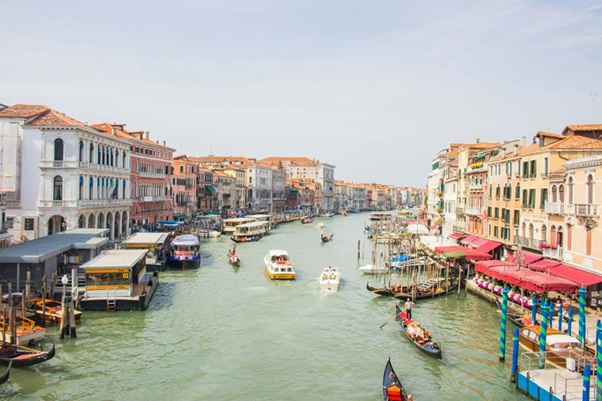
As the sun descends, the city’s texture changes. The limestone glows, and the shadows in the canals deepen into an opaque green. This is when Venice regains its elegance. The transition from day to night is best observed from the water, but away from the chaotic gondola circuits. A private launch toward the Giudecca Canal provides a panoramic view of the skyline without the claustrophobia of the crowds.
An “elegant evening” in Venice is defined by intentionality. It is found in a corner table where the lighting is dim and the acoustics allow for actual conversation. It is the choice of a wine that speaks of the volcanic soil of the Veneto, paired with service that is observant rather than intrusive. The goal is to end the day without the exhaustion typical of tourism, but rather with a sense of mental clarity.
A Deliberate Sanctuary
The success of a Venetian retreat for two depends entirely on the choice of “home base.” When the city outside is a labyrinth of stone and water, the interior space must offer a counterpoint of softness and order. By choosing a residence that prioritizes artisanal detail and architectural heritage, you ensure that the “silent mornings” don’t end at the doorstep.
Venice, when approached with this pragmatic focus on comfort and atmosphere, ceases to be a checklist of monuments. It becomes a shared study in slow movement, where the most memorable moments are found not in the grand gestures, but in the steady, elegant pulse of the city at rest.